~ Hunter Manzer
Over the last few weeks, I have become infatuated with the process of Consumer Ethnography. In particular, I am interested in the possible insights generated from the research technique. How does it differ from other qualitative methods? Is it worth the hassle of traveling to your respondent to see them in their natural environment? What different skills would I need to develop in order to perform an ethnography apposed to a regular interview?
Lots of questions arose, but still after days of online research, many remained unanswered. Something about the difficulties and boons of the process still seemed a bit blurry to me. I still didn’t feel comfortable calling myself familiar with ethnography.
It was a this point I decided there was only one way to find out. Only one way to ensure I had a firm grasp on ethnographic research. I had to do one myself.
At first, it felt as if I was floating in a great ocean of possibility. Many possible studies crossed my mind, some seemingly achievable, some a bit out of my budget. I thought briefly of following around illegal immigrants and asking them about their work lives. Dr. Candice Hollenbeck, A continuous help throughout my journey as an amateur Ethnographer, wisely advised against that can of worms. Another Idea was Netnography. My idea was to track a specific users entry, activity, and current thoughts on a niche internet community (with their consent of course). This fizzled out when I realized how difficult it would be to keep anonymity in this process.
Finally, with the help of Dr. Hollenbeck, I found my final idea. I would study the device usage of older adults (50+). Specifically, this study would be for the purpose of informing device designers how to better accommodate the needs of these older adults. To me, This topic hit all my major needs. It was altruistic, fun, and interesting.
With help from Dr. Hollenbeck, and a new friend and ethnographer, Noel Adams (CEO of Clearworks), I developed a more concrete focus for my study.
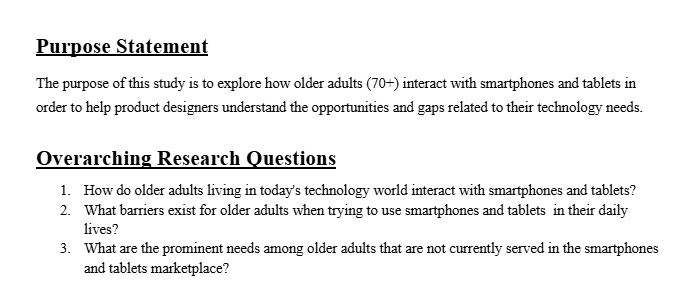
With these goals and questions set out, it was time for me to develop a discussion guide. This was a trickier process than I inticipated.
Initially I created a guide that mirrored the interview guides I had previously made. However, this would not be an interview. This would be an Ethnography. I would be in their homes, looking at how they use their devices in their natural state.
As Noel pointed out, “You are in their homes, You might as well use it”.
Additionally, this would need to be more of a free flowing conversations than a set of questions and tasks. I would need to have the respondent be comfortable enough to use their technology as they normally would.
And so I took Noel’s sage advice and restructured my guide with her help. Instead of constructing an artificial conversation with a set of interview questions, I created an initial prompt to get my respondent talking, and small notes for myself throughout my guide, reminding me in which ways, and how, I could steer the conversation.
Eventually, I had a fully functional Ethnography guide with clear goals, and clear instructions on how to meet them.
Now that leads us to the present. I will post my next update on this process when I have conducted all my Ethnographies and generated the insights from them.
Thanks for reading
~Hunter Manzer
P.S ~ I posted the entire moderators guide below
Big Thanks to Noel Adams and Candice Hollenbeck for their help so far!
 Hunter Manzer
Leave a comment