Over the past few weeks, as I’ve spoken with professors and industry professionals about algorithmic segmentation, I’ve repeatedly heard the phrase, “Segmentation is more art than science.” Yet, despite this sentiment, much of my education has been dedicated to learning precise, structured methods to execute this so-called “art.” In an industry where statistical rigor must separate fact from subjective theory, I’ve been left wondering: How can segmentation be conducted in a way that maximizes its utility while minimizing its shortcomings? Because, despite its flaws, segmentation remains an essential piece of the marketing research puzzle.
At a recent insights conference, I had the opportunity to hear Ava Toro, Agency Lead of Strategic Insights at Reddit, discuss stereotypes in marketing research. One key takeaway stood out: People are intersectional. In other words, individuals are more than just the demographic groups they belong to.
For example, a segmentation study might indicate that the primary consumers of a budget soda brand are budget-conscious women aged 18 to 34. However, if you take two individuals from this segment and ask why they buy the product, their reasons may be vastly different.
One might be a young mother struggling to make ends meet, choosing budget sodas as an affordable way to treat her kids. The other might be a college senior who simply enjoys carbonated drinks and opts for a cheaper brand to save money.
Though both consumers fit the same demographic profile, their motivations—and how they interact with the brand—are unique. On paper, they are categorized as the same, yet their realities could not be more different. One buys sparingly for herself, the other buys regularly for her children. One is a student, the other a single mother. This, I believe, is what Ava meant when she said people are “intersectional.” They are too complex, too varied to be confined within 3–6 clusters on a two-axis graph. More concerning than merely oversimplifying consumer segments, these methods risk reinforcing stereotypes, the very thing Ava warned against.
If segmentation carries these inherent risks, why do we continue to use it?
Because it is useful. Segmentation is a valuable tool for visualizing different consumer groups and serves as an excellent launching point for deeper research.
The real question is not “Why do we use it?” but “How do we improve it?”
This is the question I have been wrestling with. Through discussions with professors and professionals, I have sought to identify the shortcomings of segmentation and explore potential solutions.
It is important to acknowledge that, like all research methodologies, segmentation will never be perfect. At its core, segmentation is about grouping people based on shared characteristics. However, as Ava reminded us, no two people share the exact same intersection of traits. Consumers are inherently diverse.
So how can we maximize the utility of this imperfect art?
First, we must examine how we segment.
In the article “How Can Algorithms Help in Segmenting Users and Customers?” the authors analyze 172 studies on segmentation, identifying 46 different algorithms and 14 segmentation evaluation techniques.
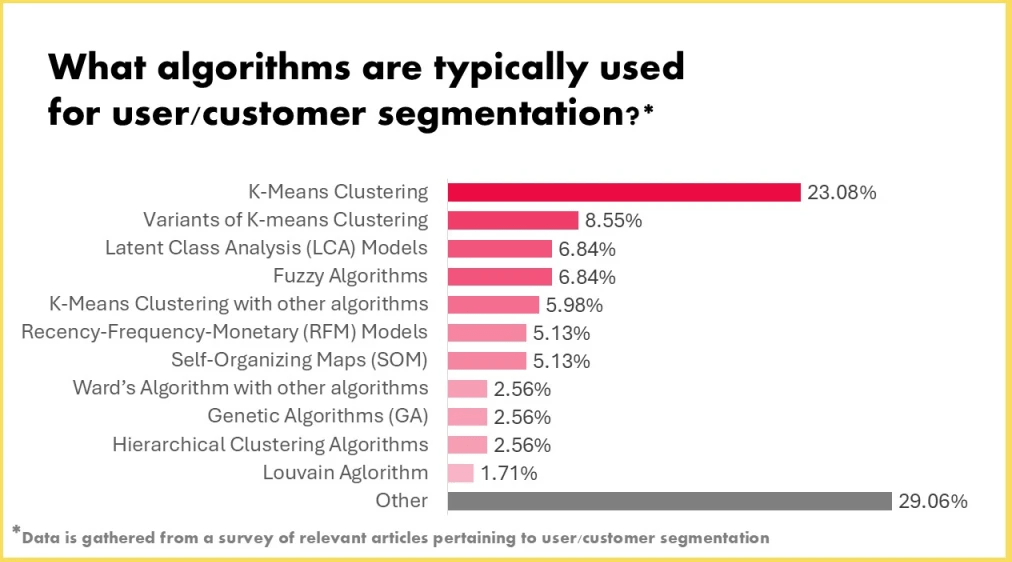
Among these, K-means remains the most widely used due to its simplicity.
If you’re interested in a deeper analysis of popular segmentation techniques and their weaknesses, I have an entire project in my portfolio on this subject.
One observation stood out during my own experiments with various segmentation algorithms: the outputs were remarkably similar.
This requires further research beyond the scope of a single master’s student, but it gave me a broader perspective on the issue. The algorithms themselves—while imperfect—are not necessarily the problem. The real issue lies in how they are applied.
Only 4.1% of the studies in the aforementioned review incorporated subject matter experts into their segmentation methods.
This brings me to what I believe is the fundamental flaw in segmentation.
Amidst the complex algorithms, coding, and statistical models, I had overlooked the most important part of the process:
The consumer.
As Ava emphasized, people are not defined by a single group. They are intersectional. No algorithm that clusters individuals around mathematical centroids can fully capture their complexity.
The human element is often what segmentation misses. Our goal should not be to create rigid consumer groups but to understand our audience’s values so we can better cater to their needs.
Segmentation should be a starting point in consumer research—a tool for exploration rather than a definitive conclusion. It should serve as just one piece of the broader research puzzle, helping us navigate the infinitely diverse landscape of consumers.
Segmentation should never be the sole foundation of our research. It is, after all, just another tool in the toolbox.

 Hunter Manzer
Leave a comment